
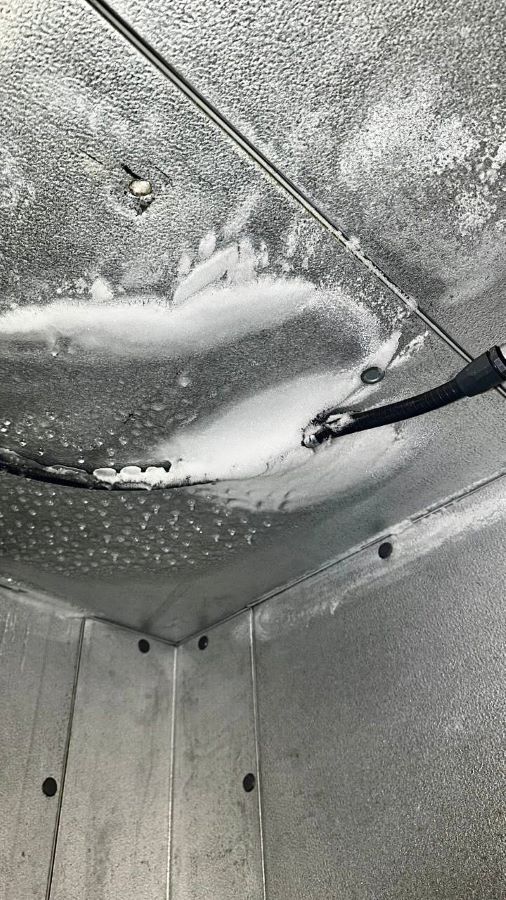
Direct answer: A walk-in freezer that ices up on the evaporator is usually losing airflow, failing defrost, or pulling in moist air. On low-temp boxes, that ice blocks heat transfer, raises product temperature, and can lead to compressor damage if the unit short-cycles or runs continuously.
This guide is for walk-in freezers only (low-temperature). Medium-temp walk-in coolers follow different defrost and control logic. For coolers, see walk-in cooler repair or our walk-in cooler diagnostics case study (medium-temp—not freezer).
What you may notice in the kitchen
- Frost or solid ice on evaporator fins, not just light hoar frost
- Box temperature drifting upward during service
- Long run times, short cycles, or a compressor that never seems to rest
- Water or ice on the floor near the evaporator drain (freeze-back)
Three common root causes
1. Airflow restriction
Blocked evaporator fans, failed fan motors, or ice so thick that air cannot pass the coil will drop capacity fast. In Puget Sound kitchens, grease vapor and box loading can accelerate fin blockage if coils are not maintained.
2. Defrost system faults
Freezers rely on timed or demand defrost with heaters and termination controls. A stuck timer, weak heater, bad termination thermostat, or failed defrost contactor leaves ice on the coil cycle after cycle.
3. Moisture intrusion (door seals and usage)
Worn door gaskets, heaters, or frequent door openings during humid weather load the box with moisture. That moisture freezes on the coldest surface—the evaporator—faster than defrost can clear it.
Field checks we run (sequence of operation)
- Verify the call for cooling — box temp, thermostat, and refrigerant solenoid behave as expected.
- Inspect airflow — fan operation, coil fin condition, and ice thickness before blaming charge.
- Run or observe a defrost cycle — heaters energize, fans stop, termination ends defrost at the right coil temperature.
- Check doors and gaskets — dollar-bill gasket test, frame heat where equipped, frost trails at openings.
- Drain path — on freezers, a blocked drain can refreeze and mimic a failed defrost.
A/C Dr. Naz is EPA Section 608 Universal certified for commercial refrigeration work. We diagnose with measurements—not guesswork—before recommending parts or refrigerant work.
What not to do
- Do not only chip ice and walk away; the fault that caused icing will return.
- Do not assume “it needs gas” without leak testing—low charge can ice a coil, but airflow and defrost failures are more common.
- Do not treat a freezer like a cooler—controls and defrost strategies differ.
When to schedule service
Call if ice returns within 24–48 hours after clearing, the box cannot hold setpoint during service, or the compressor is short-cycling. Inventory at risk on a low-temp box is a same-day priority when our schedule allows.
Service areas include Greater Seattle and Puget Sound. Start with walk-in freezer repair, walk-in freezer repair in Seattle, or commercial refrigeration repair. Call (425) 535-8990 or request a callback.