
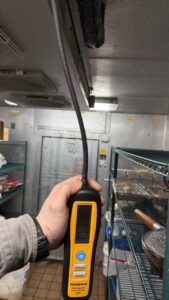
When a walk-in, prep table, or line refrigerator drifts warm in a Puget Sound restaurant or grocery, the clock is on your inventory—not on a textbook diagram. This guide explains what we check first, in plain order, so you know why a good technician does not jump straight to “low charge.”
A/C Dr. Naz provides commercial refrigeration repair and diagnostics (commercial properties only). We are EPA Universal certified and separate walk-in cooler (medium-temp) work from walk-in freezer (low-temp) work.
First checks when temperatures rise
- Is the box actually calling for cooling? Thermostat, defrost mode, and door switches can leave the compressor off while the room warms.
- Are fans running? Dead evaporator or condenser fans mimic low charge and burn compressors.
- Is the coil iced or blocked? Heavy frost stops airflow; fixing charge without fixing defrost or airflow brings the problem back.
- Are doors sealing? Gaskets, closers, and strip curtains matter on busy nights.
After controls and airflow: refrigeration readings
When the electrical sequence and airflow look correct, we compare suction and head pressures, line temperatures, and superheat/subcooling (where the system type allows) to manufacturer expectations—not to a generic “looks fine.” That is how we tell a metering problem from low charge, a restricted drier, or a failing valve.
If charge is low, we search for a leak before recharging. See our guide on refrigerant leak detection for why topping off alone fails.
Keep coolers and freezers separate
A medium-temp walk-in cooler and a low-temp walk-in freezer are not the same repair. Freezers need attention to defrost termination, door heat, and longer pull-down times. Route each asset to the right hub: walk-in cooler repair and walk-in freezer repair, under commercial refrigeration repair.
When to call for emergency diagnostics
Call when product is out of safe holding range, the box will not recover after a normal defrost cycle, or the same unit has needed repeated refrigerant. Same-day diagnostics may be available when capacity allows—(425) 535-8990.
What should I do first when a walk-in or line refrigerator starts warming up?
Note the temperature trend, whether the compressor and fans are running, and any recent door, defrost, or power events. Do not keep resetting breakers or adding refrigerant without a leak search. Call for diagnostics if product is approaching unsafe holding temperatures.
Why does my technician check controls before refrigerant pressures?
Many warm-box calls are electrical or airflow problems—failed contactors, defrost stuck on, iced evaporators, or thermostats not calling. Verifying what should energize first avoids misreading pressures and replacing parts that are not failed.
Are walk-in coolers and freezers diagnosed the same way?
No. Coolers are medium-temperature systems; freezers are low-temperature with different defrost, door heat, and control behavior. Mixing the two in one repair plan often leads to wrong parts and repeat callbacks.