Commercial HVAC Repair in Redmond, WA
Rooftop unit losing its cool a little more each week, or a tech before us who just kept adding refrigerant? This page is about leaks: finding them, fixing them, and recovering refrigerant the legal way on commercial systems.

When the board has room we can be there today, and sites that have lost cooling or ventilation outright are seen first; the A/C Dr. Naz homepage explains the order we work in.
Low on refrigerant means a leak
Refrigerant doesn’t get used up. If a system is low, it is leaking somewhere, and topping it off only buys a few weeks. The job is to find the leak, repair it, prove the repair holds and then charge the system correctly.
Signs a system may be leaking
- Cooling that fades over days or weeks rather than stopping all at once
- Ice on the suction line or the indoor coil
- Oily residue around fittings, valves or coil joints
- A hissing sound near the unit when it shuts off
- The same unit needing a recharge every season
How we track a leak down
Pressures and temperatures go on digital manifold gauges first, so we know how far off the charge is. From there the tech checks the usual suspects, such as flare fittings, service valves and coil joints, using electronic detection and bubble solution, then repairs the leak and checks the repair before any refrigerant goes back in.
Economizer & sensor diagnostics (FAQ)
Compressor electrical forensics for commercial splits
Heat pump reversing-valve checks we document
Make-up air blower imbalance markers
Total external static pressure capture
RTU repair for rooftop packages


Service area
Commercial HVAC repair in Redmond covers Overlake offices, downtown and the town center, and the business parks along Willows Road. Traffic on 520 and 405 shapes the arrival time, so it’s set on the phone.
Unit keeps needing refrigerant? When you call for commercial HVAC repair in Redmond, say how often it has been recharged and dispatch will plan for leak testing.
Related Eastside and metro pages:
- Bellevue
- Seattle
- Everett has a page of its own up north
- Edmonds
- All HVAC service areas
Where leaks tend to show up
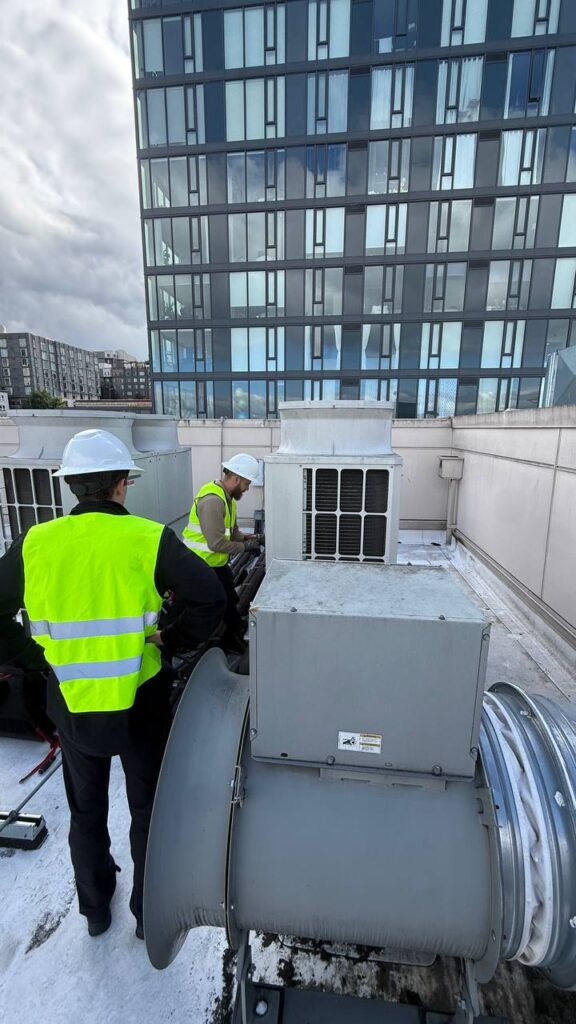
Most leak calls involve packaged rooftops and split systems on offices and labs, where long line sets and many joints give refrigerant plenty of ways out. Full rooftop package work is handled under RTU repair.
Common leak points
- Flare and compression fittings that loosen with vibration
- Service valve caps and cores left loose
- Evaporator coils with corroded or rubbed-through tubes
- Condenser coils damaged by hail, debris or a pressure washer
After the leak is fixed
- The repair is checked before the system is recharged
- Charge is set by measured superheat or subcooling, not by guesswork
- Running amps are compared with the nameplate
- Readings and the repair are written in the visit summary
Refrigerant rules we follow
Refrigerant is pulled out with recovery equipment, never vented, following EPA Section 608; our EPA Universal certification page explains the license involved.
A same-day leak call is possible when capacity allows, otherwise dispatch gives you the earliest real slot.
Once recharged, the unit runs through its HVAC/R sequence of operation so we can confirm stable pressures through every stage.
Leak and refrigerant reading
These field notes go deeper into refrigerant readings, compressor checks and system testing for anyone managing the equipment.
RTU economizer logic deep dive · Compressor electrical isolation order · Heat pump reversing-valve checklist
MUA blower field markers · External static capture methodology · Published field-note index
Refrigerant leaks in occupied spaces can raise safety questions; the EPA indoor air resource and OSHA indoor environmental guidance cover the basics.
Coolers and freezers
Leaks on walk-ins, reach-ins and ice machines are handled through the commercial refrigeration repair hub; this page stays on comfort systems.
Refrigerant leak questions
Can you just top off my refrigerant?
We don’t offer a top-off as the fix. The leak is found and repaired first, and leak visits are same-day when capacity allows.
How do you find a small leak?
Gauges show how low the charge is, then electronic detection and bubble solution pinpoint the spot. We take commercial service calls only.
What refrigerants do you handle?
The common commercial ones, including older systems. Share the nameplate when you book so the tech brings the right refrigerant and recovery setup.
How do I report a leak?
Ring (425) 535-8990 and mention how many recharges the unit has had, or note that on the contact form along with the street address.
Is there a broader FAQ?
Our FAQ page has short answers about service, timing and areas.
Rooftop unit losing refrigerant at your building?
Timing depends on 520 and 405 traffic, the queue and parts, and the dispatcher gives you a window on the call.