
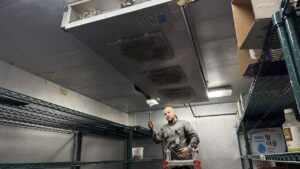
If your walk-in, prep table, ice machine, or rooftop unit keeps losing cooling and someone suggests “just adding gas,” pause. Low refrigerant means a leak. Topping off without finding the source costs you every month and can damage the compressor.
A/C Dr. Naz is EPA Section 608 Universal certified for commercial HVAC/R work in the Puget Sound area. We locate leaks, repair them, pull a proper vacuum, and recharge to spec—so the system holds temperature without repeat visits.
Signs you may have a leak
- Slow temperature drift that gets worse over weeks
- Ice on the evaporator that returns soon after defrost
- Hissing at fittings (only when the system is pressurized—do not rely on smell alone)
- Short run times or a compressor that never seems satisfied
- A service history of “added refrigerant” with no leak search noted
How we find leaks (beyond soap bubbles)
Soap tests help on obvious joints, but many commercial leaks are too small to bubble consistently—especially on coated coils or vibration-prone line sets.
- Visual and mechanical check — oil traces, vibration wear at stubs, valve cores, filter-drier fittings, condenser coil damage.
- Electronic detection — heated diode or ultrasonic tools rated for your refrigerant type.
- Pressure and isolation — when needed, nitrogen pressure helps confirm a leak before major component work.
- Repair and verify — braze or replace the failed joint, evacuate moisture, recharge, and confirm stable temperatures over time.
Cooler, freezer, or rooftop unit?
Walk-in coolers (medium-temp) and walk-in freezers (low-temp) use different controls and failure patterns—treat them as separate assets. Rooftop units and split AC on the building share the same leak-finding methods but different access and safety steps on the roof.
For cold-side service, see our commercial refrigeration repair hub, walk-in cooler repair, and walk-in freezer repair pages.
When to call for diagnostics
Call when temperatures are out of spec, product is at risk, or the same unit needed refrigerant again within a year. Same-day diagnostics may be available when capacity allows. Call (425) 535-8990 with the equipment nameplate and when the problem started.
Is it okay to add refrigerant to a commercial unit once a year?
No. Refrigerant should stay in a closed loop. If you need annual top-offs, you have a leak. Repeated charging wastes money, risks oil loss and compressor damage, and violates EPA rules. Find and repair the leak, then verify charge.
How do technicians find small refrigerant leaks?
After checking common leak points (flares, valve cores, coil joints), we use electronic leak detectors—heated diode or ultrasonic—often with nitrogen pressure for hard-to-find leaks. Soap bubbles alone miss many small leaks on walk-ins and rooftop units.
Does a leak on a walk-in cooler affect my freezer too?
Only if they share the same refrigeration circuit, which is uncommon. Medium-temp coolers and low-temp freezers are separate systems. Diagnose each box on its own.