
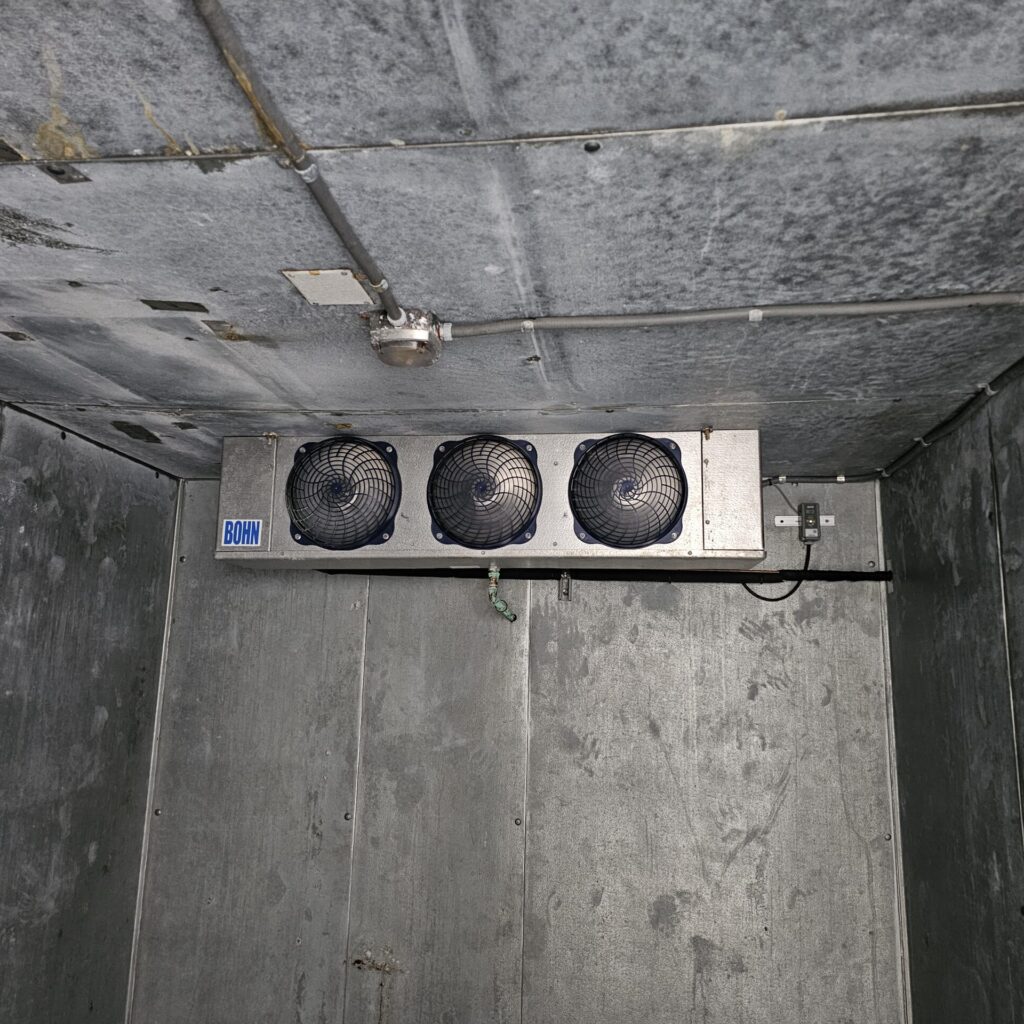
In the restaurant business, silence is golden—until it comes from your compressor. When that hum stops, the clock starts ticking. Spoilage costs money, but lost revenue during a dinner rush costs even more. Inside the refrigeration service and repair process: What every owner should know.
After years in the field, I’ve seen it all: from Ballard breweries to Pike Place florists. The most common question I get asked is, “How often do I really need to call you?”
The short answer: It depends on your menu and your location. But relying on reactive repairs instead of refrigeration service and repair is a gamble that the house usually wins.
Here is the reality of maintaining commercial cooling equipment in the Pacific Northwest, and why our specific climate makes a difference.
The General Rule of Thumb: Frequency Matters
There is no “one size fits all” schedule, but there are industry standards based on the load your equipment carries.
- Quarterly (Every 3 Months): Essential for high-grease environments. If you are running a burger joint, a fry-heavy kitchen, or a bakery with airborne flour, grease and particulate matter coat condenser coils fast. This acts as a blanket, suffocating your fridge.
- Semi-Annually (Every 6 Months): Standard for general retail, florists, coffee shops, or pre-packaged grab-and-go coolers (like in a cafeteria).
- Annually: Only acceptable for self-contained units in very clean, climate-controlled office environments.
The Difference Between a “Check-Up” and “Service”
Don’t confuse a quick look-over with a proper service call. Commercial fridge maintenance in Seattle involves more than wiping down shelves. In the refrigeration service and repair process. A true service visit includes chemically cleaning the coils (crucial here where damp air sticks dust to everything), tightening electrical connections, checking refrigerant pressures, and verifying the superheat and sub cooling.
In Seattle, we have to be more careful than most. Under the Washington State Refrigerant Management Program, many business owners are now required to register their systems and conduct periodic leak inspections to reduce greenhouse gas emissions.
Case Study: Anatomy of a Shoreline Repair
This is why you hire a pro, not just a handyman.
To show you exactly why expert diagnostics matter, I’ll walk you through a job I handled recently.
I received a call from a Shoreline, WA restaurant on a Saturday morning (February 2026). The owner was panicking; their main walk-in cooler was warming up, and they had a busy weekend ahead.
We offer same-day service, so I scheduled the inspection right away.
When I arrived, the kitchen was already buzzing. A less experienced tech might have walked in, heard the compressor struggling, and immediately quoted the owner for a brand-new compressor. That’s an expensive guess. I make sure to find what’s wrong before changing parts.
The Technical Deep Dive
To figure out what was happening, I had to analyze the “Sequence of Operation.” If you don’t know how the machine is supposed to start, you can’t tell why it’s failing.
My sequence of operation for walk-in cooler repairs typically starts here:
- The Call for Cooling: The T-Stat (Thermostat) closes and energizes the solenoid valve.
- Pressure Build: The solenoid opens, allowing refrigerant to flow. Consequently, suction pressure rises, closing the LP (Low Pressure) Control.
- Ignition: The contactor pulls in, and the system starts.
However, in this Shoreline kitchen, the system was trying to start but couldn’t maintain the cycle.
Expert Insight: The “Seattle Setting”
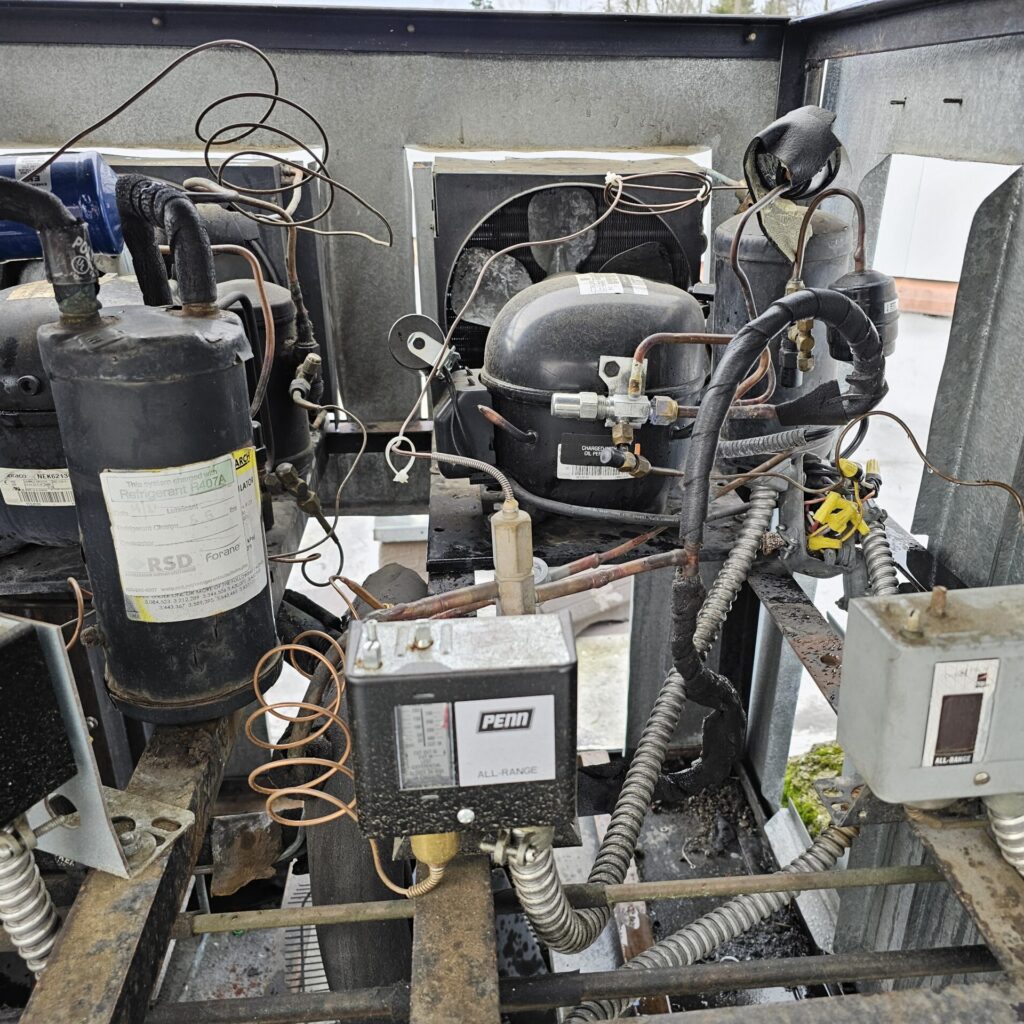
One thing I checked immediately was the Low Pressure (LP) Control settings. These need to be calibrated for our specific climate.
Your LP Control settings should be cut in below the average ambient low temp. If the condensing unit is outdoors in Seattle, I look for 35#’s for the cut-in pressure. The cut out should be set to 10 – 15#’s.
If these are set wrong, our chilly, damp nights can trick the machine into staying off, or short-cycling until it burns out.
The Problem and The Fix
In this case, the settings were okay, but the amp draw on the compressor was skyrocketing.
Worn or damaged start components will cause hi amp draw. My meter confirmed the start capacitor and relay were shot. But why?
It turned out to be an oil issue. The system had been short-cycling due to a previous technician overcharging the system, causing oil logging which put massive strain on the start components.
I replaced all start components, including the contactor. And the problem was solved.
If I had just swapped the capacitor without finding the root cause (the short cycling/oil stress), that part would have blown again in a month. Instead, one of hundreds of walk-in coolers I’ve repaired was running perfectly again.
Why “Parts Changers” Cost You More Money
In the walk-in cooler repair business, we have a name for guys who just swap components until the machine turns on: “Parts Changers.”
They replace the most expensive part first (the compressor (the heart of the fridge)) because they don’t understand the sequence of operation. In the story above, a “Parts Changer” might have charged that Shoreline owner $2,500 for a new compressor. I fixed it for a fraction of that price by diagnosing the start components and correcting the pressure issues.
Proper restaurant equipment maintenance isn’t an expense; it’s an insurance policy against incompetence.
Find more guides and refrigeration service and repair tips on our blog and resources page
3 Signs You Need Service Now (Before it Breaks)
Don’t wait for the “Emergency Refrigeration Service Shoreline” Google search. Look for these signs:
- Rising Energy Bills: If your utility bill jumps but your usage hasn’t changed, your fridge is running a marathon just to stay cool.
- Ice Buildup on the Evaporator: If you see ice inside the cabinet, you have an airflow issue, a defrost failure, or low refrigerant. This kills compressors.
- Short Cycling: If you hear your fridge turning on and off every few minutes (rather than running a long, steady cycle), call a pro immediately.
Conclusion
Living in the Pacific Northwest, we deal with unique challenges—high humidity, pollen, and temperature fluctuations. Your refrigeration equipment feels those changes just as much as you do.
Regular maintenance prevents the 2:00 AM panic calls and keeps your inventory safe. Whether you are running a cafe in Capitol Hill or a bistro in Lynnwood, treating your equipment right is the key to longevity.
Maintaining a steady temperature isn’t just about preventing ice; it’s about compliance. The FDA Food Storage Chart mandates that all refrigerators must keep perishable foods at 40°F or below to prevent the growth of harmful bacteria.
Need a check-up? Don’t wait for the heat of summer. Book your refrigeration service and repair today and let’s make sure your walk-in is ready for the rush.