
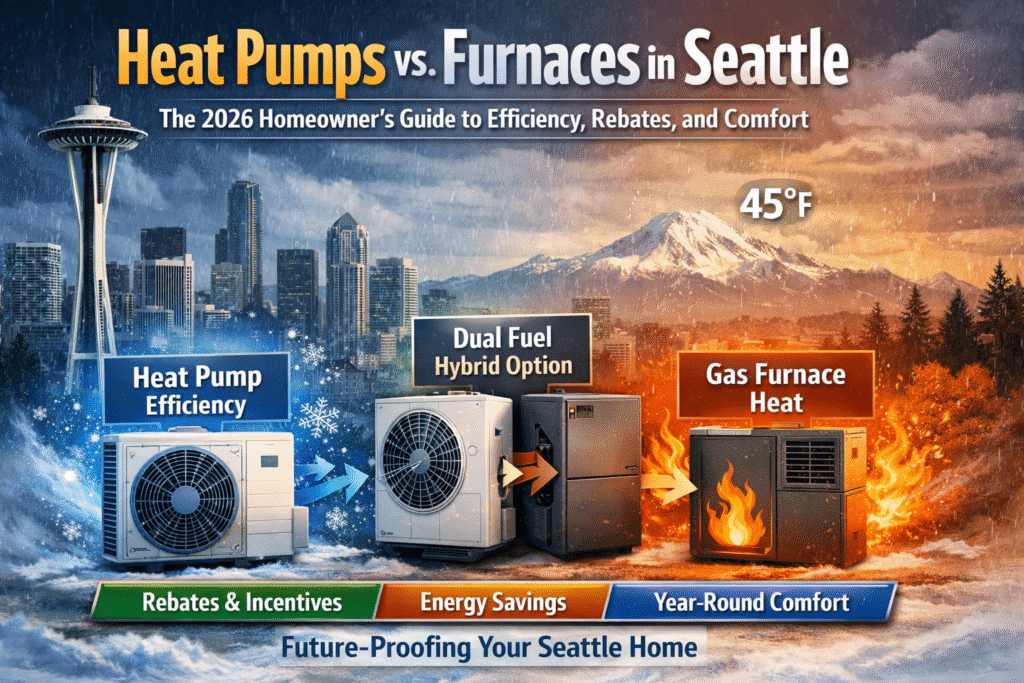
The “Seattle Chill” is Changing
It’s January 2026. You know the feeling. It’s 45°F outside, raining sideways, and the damp cold seems to seep right through your walls. You’re sitting in your living room in Ballard or Bellevue, and your old gas furnace kicks on. It blasts you with hot, dry air for ten minutes, shuts off, and then the chill creeps back in.
For over 20 years, I’ve been crawling through crawlspaces from Shoreline to Renton, fixing systems that just can’t keep up with our specific brand of “wet cold.”
Here is the reality for 2026: The rules of the game have changed. With new Washington State energy codes, the Inflation Reduction Act (IRA) fully matured, and natural gas prices fluctuating, the decision between a furnace and a heat pump isn’t just about comfort—it’s about future-proofing your home.
If you are confused by terms like HSPF2, “electrification,” or dual fuel, you are not alone. Let’s cut through the noise.
The Technical Reality: Busting the “Cold Weather” Myth
The biggest lie I hear from homeowners is: “Heat pumps don’t work in the cold.”
Maybe that was true in 1995. It is not true in 2026.
Here is the physics, simplified. A gas furnace works by Heat Creation. It burns fuel to create fire. It is brute force. A heat pump works by Heat Transfer. Even in 35°F air, there is heat energy. A heat pump uses refrigerant (R-454B or R-410A) to absorb that heat energy from the outside air, compress it (which makes it hot), and move it inside.
The Secret Weapon: The Inverter
Old heat pumps were “all or nothing”—running at 100% capacity or 0%. Modern systems use Inverter Technology. Think of it like a dimmer switch or the gas pedal in your car. When it’s 45°F and drizzling, the system cruises at 30% capacity, maintaining a perfect, steady temperature. It doesn’t blast you; it hugs you with warmth.
In Seattle, our “design temperature” (the coldest it usually gets) is roughly 24°F. Modern heat pumps maintain 100% efficiency down to 5°F or lower. We are in the perfect “Goldilocks” zone for heat pumps.
Technical Note: In 2023, the industry switched to HSPF2 (Heating Seasonal Performance Factor 2). If you are looking at specs, don’t compare an old HSPF rating to a new HSPF2 rating. A 9.0 HSPF2 is significantly more efficient than a 9.0 HSPF.
Comparison: Gas Furnace vs. Heat Pump vs. Dual Fuel
Visualizing the difference is key. Here is how they stack up for a typical 2,000 sq. ft. Seattle home in 2026.
| Feature | Gas Furnace (96% Efficiency) | Electric Heat Pump (Inverter) | Dual Fuel (Hybrid) |
| Primary Energy Source | Natural Gas | Electricity | Electricity + Gas Backup |
| Best For | Fast, high-heat recovery. | Consistent, steady warmth & AC. | The “Safety Net” buyer. |
| Summer Cooling? | No (Must add A/C). | Yes (Built-in). | Yes (Built-in). |
| Monthly Cost (2026) | High (Gas rates rising). | Low (High Efficiency). | Lowest (Smart switching). |
| Lifespan | 15–20 Years | 12–15 Years | 15–20 Years |
| Carbon Footprint | High | Low | Moderate |
For a deeper dive into system replacements, check our guide on Air Conditioning Installation.
While a modern furnace can last up to 20 years, unexpected issues like ignition failure or blower motor stress are common in our damp climate. If your current system is struggling to keep up, our team provides expert furnace repair in Seattle to restore your comfort before considering a full replacement.
The “Seattle Factor”: Why Moisture Matters
In the Pacific Northwest, cold isn’t our enemy. Humidity is. Seattle homes suffer from “Sick Building Syndrome.” We seal our homes tight to save heat, but that traps moisture.
- The Furnace Problem: A gas furnace dries out the air rapidly when it runs, but because it cycles off frequently, humidity builds back up in between cycles. This yo-yo effect can warp wood floors and irritate sinuses.
- The Heat Pump Advantage: Because an inverter heat pump runs longer at a lower setting, it constantly circulates air through the filter.
- Summer Relief: We used to say, “You don’t need A/C in Seattle.” Tell that to anyone who lived through the heat domes of the 2020s. A heat pump is an air conditioner. It pulls humidity out of your home in the summer, preventing that musty “crawlspace smell” and mold growth.
If you are already seeing issues with indoor air quality, visit our Air Conditioner Services page to learn about dehumidification.
The Financials: 2026 Rebates & Incentives
This is the year to buy. Between Washington State’s push for decarbonization and federal incentives, thousands of dollars are on the table.
1. The Federal Tax Credit (IRA – 25C)
The Inflation Reduction Act is still in full swing.
- The Deal: You get a tax credit of 30% of the installation cost, capped at $2,000 per year for heat pumps.
- Note: This is a dollar-for-dollar reduction in your tax bill, not just a deduction.
- Learn more: 25C Tax Credit or Energy Star Guide.
Utility Rebates (PSE & SCL)
Local utilities are paying you to stop using so much energy.
- Puget Sound Energy (PSE): If you are switching from an electric furnace or baseboards to a heat pump, rebates can range from $800 to over $2,000 depending on the efficiency (HSPF2 rating) of the unit.
- Seattle City Light: They offer instant discounts for approved contractors (like us) that we pass directly to you.
- Check current offers: PSE Rebates or Puget Sound Energy.
3. Washington State Strategy
The state is aggressively moving away from fossil fuels. New construction in many parts of King County already restricts gas. Installing a high-efficiency electric system now increases your home’s resale value as these regulations tighten.
- Read the strategy: Washington State Department of Commerce.
The Hybrid Solution: “Dual Fuel”
Are you worried about a massive power outage? Or maybe you just love that “toasty” feeling of a gas furnace on a 20°F morning?
Get a Dual Fuel System. This pairs an electric heat pump with a gas furnace.
- 90% of the time: The heat pump heats your home efficiently (and cheaply).
- The Freeze: When temps drop below 30°F (or whatever set point we program), the gas furnace kicks on to help.
- The Benefit: You get the rebates of a heat pump, the A/C for summer, and the safety net of gas heat.
This is often the best choice for homeowners in older Seattle homes with existing ductwork. If your home lacks ductwork, you should be looking at Mini Split Installation for a zoned solution.
A Note for Business Owners
If you own a commercial building in King County, these same rules apply to you, but the fines for inefficiency are getting steeper (Clean Buildings Performance Standard). We handle these retrofits regularly. See our Commercial HVAC Repair section for details on compliance.
At A/C Dr. Naz, our 2026 recommendations are backed by real-world data. We document our diagnostic workflows—from 500-micron evacuations to complex control board fault isolation—in our Technical Knowledge Base. Read our latest field reports to see how we maintain the highest standards in the Pacific Northwest.
Don’t Guess, Calculate
In 2026, you cannot just swap a 100,000 BTU furnace for another 100,000 BTU furnace. That is the old way. To get the permits, the rebates, and the comfort, you need a Manual J Load Calculation. This calculates exactly how much heat your home loses through its specific windows, insulation, and layout.
Don’t let a “truck and a ladder” guy guess with your comfort.
Is your furnace costing you too much? Call A/C Dr. Naz today. We will assess your current system, calculate your load, and help you navigate the 2026 rebates to get the perfect system for our Seattle weather.