
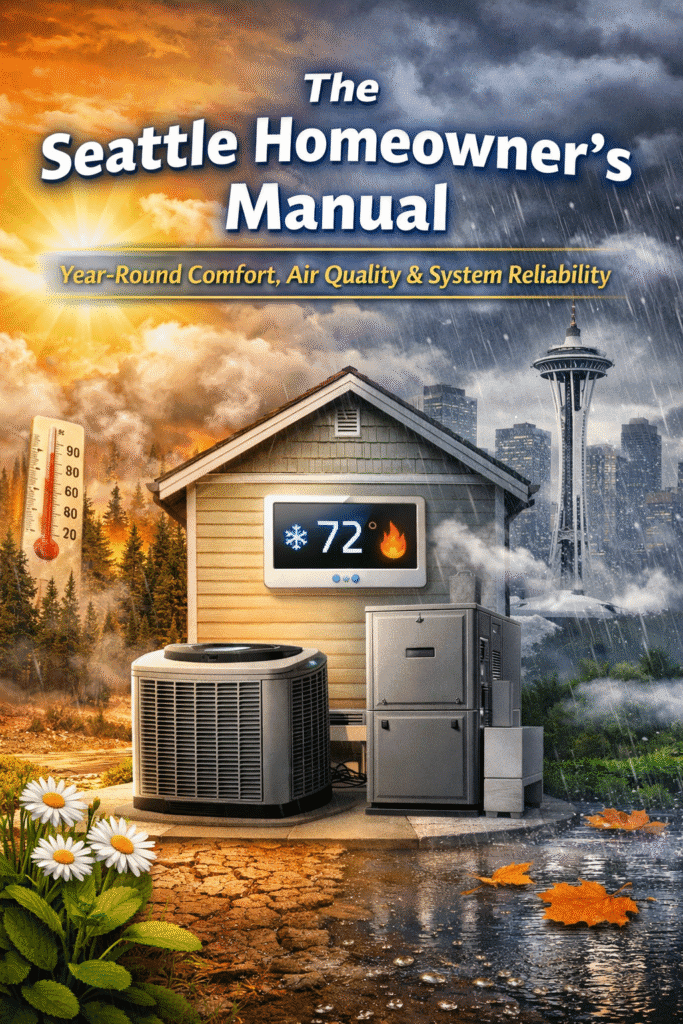
For decades, the Pacific Northwest was known for one weather pattern: the “Seattle Gray.” Homes were built to keep the rain out and the heat in, often ignoring cooling entirely. But if you’ve lived in Bellevue, Renton, or Seattle for the last few years, you know the script has flipped.
We are now facing “Heat Domes,” “Smoke Season,” and humid winters. Your home’s heating and cooling system is no longer just a luxury—it is the primary defense line for your family’s comfort and health.
At A/C Dr. Naz, we see HVAC not just as machinery, but as a total home ecosystem. This guide is written for the Seattle homeowner who wants to understand how to maintain a healthy, comfortable home environment, regardless of what the forecast predicts.
The Changing Climate of the Pacific Northwest
Seattle’s HVAC needs have evolved rapidly. While we don’t experience the sub-zero temps of the Midwest, our maritime climate creates specific “comfort thieves” that standard systems struggle to manage if not properly calibrated.
The New Challenges:
- The Humidity Hangover: Our winters aren’t just cold; they are wet. This creates a “bone-chilling” dampness that standard thermostats often misread.
- The Summer Spikes: With temperatures increasingly hitting 90°F+, homes without AC (or with undersized units) can become dangerous “heat traps,” especially older multi-story homes in Queen Anne or Capitol Hill.
- Particulate Matter: The rise of wildfire smoke in late summer means that opening a window for a breeze is often no longer a safe option.
This shift makes HVAC services in Seattle, WA about more than just temperature—it’s about controlling your indoor environment to ensure it is safe, clean, and consistent.
Understanding Your HVAC System: The “V” is Vital
Most homeowners focus on the “H” (Heating) and the “AC” (Air Conditioning), but in the Pacific Northwest, the “V” (Ventilation) is the unsung hero.
Your HVAC system does three critical things:
- Regulates Temperature: Keeps you warm in January and cool in August.
- Controls Moisture: Acts as a dehumidifier during the damp season to prevent mold growth and clammy bedding.
- Circulates & Filters: Continually moves air to prevent stagnation and filter out dust and allergens.
The “Stuffy House” Syndrome
If your home feels stuffy in winter or humid in summer, it’s rarely a problem with your insulation—it’s usually an airflow problem. Common local issues include:
- Crushed Ductwork: Prevalent in crawlspaces of older homes in Shoreline and Everett.
- Short-Cycling: Oversized furnaces that blast hot air for 5 minutes and then shut off, failing to actually circulate the air.
Is your system actually moving air correctly? A system that can’t breathe can’t keep you comfortable. 👉 Explore our comprehensive HVAC services
AC Performance & The “Smoke Season” Reality
Ten years ago, air conditioning in Seattle was considered optional. Today, with the recurring threat of wildfire smoke, it is a health necessity. Air conditioning installation in Seattle is largely driven by the need to keep windows closed during poor air quality days without roasting inside your own home.
Air Quality (IAQ) vs. Temperature
Modern cooling systems do more than chill the air; they scrub it. When smoke descends on the Puget Sound, a well-sealed home with a central AC or heat pump system acts as a clean air sanctuary.
To maximize health benefits, we often recommend:
- High-MERV Filtration: Filters that are dense enough to trap smoke particles (PM2.5) but not so dense that they choke your furnace.
- Air Scrubbers: UV light or ionization technology installed in the ductwork to neutralize viruses, bacteria, and odors.
- Dehumidification: Critical for keeping dust mite populations low.
For more on how smoke affects indoor environments, we recommend reviewing the Washington State Dept. of Health Air Quality Guide
or the EPA’s Indoor Air Quality resources.
Breathe easier this summer. Upgrade your cooling system to protect your lungs as well as your comfort. 👉 Learn about our Air Conditioner Services & IAQ
Reliability Check: Repair vs. Replace
There is never a “good time” for your heater to fail, but it almost always happens on the coldest night of the year or the hottest afternoon of July. Deciding between AC repair in Seattle or a full replacement often comes down to reliability rather than just cost.
The “Peace of Mind” Equation
When evaluating a system, ask yourself: Can I trust this unit to get me through a week of 20-degree weather?
You should consider replacement if:
- Frequency of breakdown: You’ve had to call for repairs more than twice in the last two years.
- Noise levels: The system has become significantly louder, rattling, or humming (signs of compressor or motor strain).
- Uneven comfort: Some rooms are freezing while others are hot, indicating the system creates pressure imbalances it can no longer overcome.
- Age: Heat pumps/ACs over 12 years old and furnaces over 15 years old are entering the “hazard zone” for catastrophic failure.
While efficiency is a bonus, the primary benefit of a new system is reliability. You are buying the assurance that your home will stay comfortable. (Check ENERGY STAR for reliability ratings on new equipment).
Tired of worrying if your heater will start? Let’s discuss a system that gives you confidence, not anxiety. 👉 Details on Installation & Replacement
Solving the “Hot Upstairs” Problem: Ductless Mini-Splits
A common complaint in two-story homes in Redmond or Kent is the temperature differential: “My downstairs is freezing, but my upstairs bedrooms are 80 degrees.”
Traditional thermostats only measure the temperature in the hallway downstairs. They don’t know (and don’t care) that you are sweating in your bedroom.
The Zoning Solution
Mini-split installation in Seattle has skyrocketed because these systems solve the physics problem of heat rising.
- Targeted Cooling: You can install a head unit in the primary bedroom and cool only that room while you sleep.
- No Ductwork Needed: Ideal for older craftsmen homes, basements, or garage additions where extending ductwork is impossible or too expensive.
- Personalized Comfort: One family member can have their room at 72° while another keeps theirs at 68°.
Customize your comfort zones. Stop fighting over the thermostat and start controlling your climate room-by-room. 👉 See if Mini-Splits are right for you
The “Cozy” Factor: Heat Pumps in the PNW
We often talk about heat pumps in terms of savings, but we rarely talk about the quality of the heat.
The “Scorched Air” vs. “Warm Blanket” Effect
Gas furnaces blast high-temperature air (120°F+) for short bursts. This leads to a cycle of “too hot” followed by “getting cold.”
Heat pumps, which move heat rather than creating it via combustion, typically run for longer cycles at lower, gentler temperatures (90°F–100°F). This creates a constant wash of warmth that maintains a steady temperature, eliminating the hot/cold swings.
Because Seattle winters are mild (rarely dropping below the operational threshold of modern heat pumps), they are the ultimate comfort solution for our region. For deep dives on heat pump mechanics, the DOE Heat Pump Guide is a great resource.
Experience consistent warmth. Upgrade to the heating technology designed for the Seattle climate. 👉 View our Heating Services
Commercial HVAC: Protecting Your Business Continuity
For business owners in Seattle, HVAC isn’t just about comfort—it’s about revenue protection.
The Hidden Costs of HVAC Failure
If you manage a server room, a restaurant, or a retail space, a failure in your HVAC system halts operations immediately.
- Employee Retention: In a competitive hiring market like Seattle, maintaining a comfortable workspace is a baseline requirement for employee satisfaction.
- Customer Perception: A store that feels damp or smells musty (due to poor ventilation) drives customers away faster than high prices.
Commercial HVAC repair in Seattle requires a different skillset than residential. It involves managing complex economizers, rooftop units, and building automation systems to ensure airflow requirements are met for code compliance.
Keep your doors open and your team happy. We prioritize commercial response to minimize your downtime. 👉 Commercial HVAC Repair & Services
Preventative Maintenance: The “Reliability” Insurance
Think of preventative maintenance not as a way to save $10 on your bill, but as insurance against waking up to a freezing house on New Year’s Day.
What We Actually Do During a Check-Up
It’s not just “kicking the tires.” A proper maintenance visit involves:
- Clearing Drainage: Clogged condensate lines are the #1 cause of water damage from AC units.
- Tightening Electrical: Vibrations loosen wires over time, leading to shorts and blown fuses.
- Checking Refrigerant: Low refrigerant means a leak; catching it early saves your compressor from burning out.
The Homeowner’s Job: Filters
In the Pacific Northwest, with our pollen and moisture, filters load up quickly. A dirty filter suffocates your system, causing it to overheat and fail. Check them monthly!
Don’t wait for a breakdown. Schedule your seasonal tune-up to ensure your system is ready for the weather ahead. 👉 Book your Maintenance Service
Frequently Asked Questions (Seattle Comfort Edition)
Local Expertise Matters
The weather in Western Washington is unpredictable. Your comfort shouldn’t be.
Whether you are battling the August heat, the November rain, or the fluctuating air quality of smoke season, you need an HVAC partner who understands the local environment.
At A/C Dr. Naz, we are committed to keeping Seattle homes and businesses comfortable, safe, and reliable. We don’t just fix machines; we solve comfort problems.