
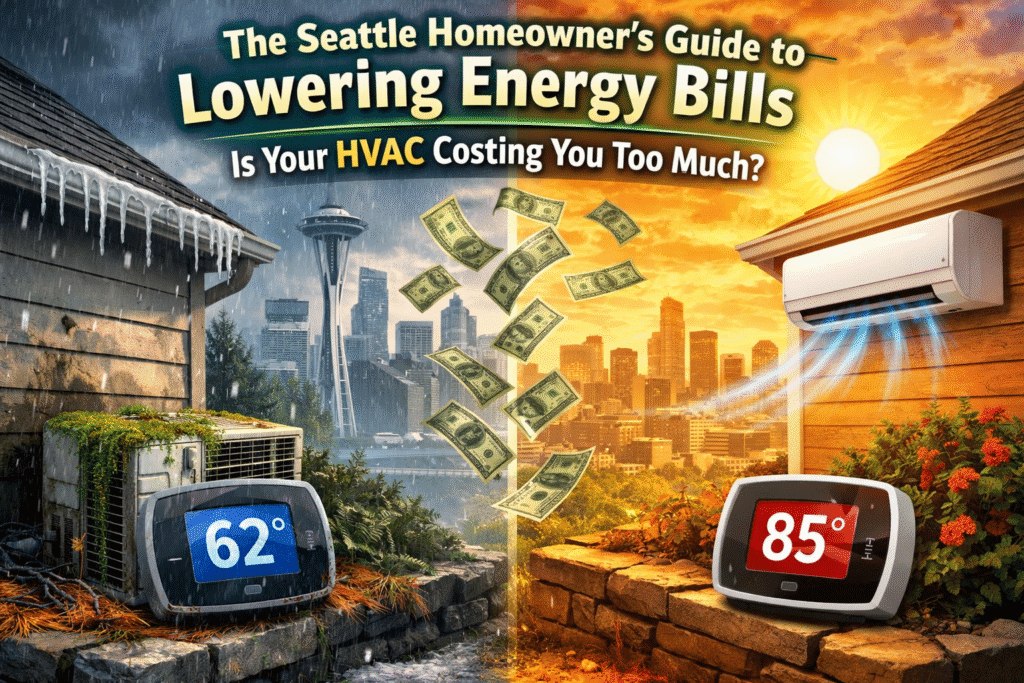
In the Pacific Northwest, we pride ourselves on our resilience. We handle the “Big Dark” with local coffee and Gore-Tex, but as we move through 2026, a new challenge has emerged for King County homeowners: the unprecedented volatility of energy costs. Seattle’s climate is no longer just a steady, predictable drizzle; we now navigate a “damp cold” that sinks into your bones in November and increasingly frequent 90-degree summer spikes in July and August.
If you’ve noticed your utility bills skyrocketing—even when your thermostat settings remain unchanged—you aren’t alone. Many homes in the Puget Sound area are equipped with aging systems that simply weren’t designed for the temperature extremes we are seeing this year. This guide explores why your system might be underperforming and how you can reclaim control over your home’s climate and your wallet.
The “Damp Air” Factor – Why PNW HVAC Systems Work Harder
In Seattle, the enemy of efficiency isn’t just the temperature—it’s the moisture. High humidity levels in the Puget Sound region significantly impact how your HVAC system performs heat exchange.
How Humidity Taxes Your System
When the air is damp, your air conditioner or heat pump has to work twice as hard. First, it must remove the latent heat (moisture) from the air before it can effectively lower the ambient temperature. If your system is older or poorly maintained, this process becomes sluggish, causing the unit to run longer cycles and consume significantly more kilowatt-hours.
The Hidden Cost of Neglect
Our local environment presents unique physical challenges to outdoor condensers. In neighborhoods like Ballard, West Seattle, or Queen Anne, three specific factors degrade system health:
- Moss and Algae Growth: The constant shade and moisture can lead to biological growth on your coils, insulating them and preventing heat transfer.
- Pine Needles and Debris: The PNW canopy is beautiful, but needles can clog drainage paths and airflow within your unit.
- Salt Air Corrosion: For those living near the Sound, salt air accelerates the oxidation of aluminum fins.
Regular HVAC services are essential to mitigate these local environmental factors before they lead to a permanent “efficiency bleed” that shows up on your monthly statement.
The Efficiency Gap – Central AC vs. Ductless Mini-Splits
Why is my electric bill so high compared to my neighbors?
Many Seattle homes built before the 2000s rely on forced-air furnaces with added central AC or, in many cases, no cooling at all. If you are using an older central unit, you may be losing up to 30% of your treated air through leaky ductwork in unconditioned spaces like crawlspaces or attics.
As we look at the energy standards of 2026, the efficiency gap between old and new technology has never been wider.
| Feature | Older Central AC | Modern Mini-Split (2026 Standards) |
| Average SEER2 Rating | 10–14 | 20–30+ |
| Zoning Capabilities | None (All or nothing) | Precise (Room-by-room) |
| Duct Loss | Significant (20-30%) | Zero |
| Installation | Invasive ductwork needed | Minimal (small wall port) |
Why Seattle Homes are Perfect for Mini-Splits
Our city is famous for its classic Craftsman and mid-century modern homes. These structures often lack the internal space for massive duct runs. By opting for a mini-split installation, you can target “problem rooms”—like that upstairs bedroom that’s always five degrees warmer—without paying to cool the entire house. This “zoning” is the single fastest way to slash your monthly energy spend.
Troubleshooting Performance (The “Doctor’s” Checklist)
Why is my AC running but not cooling the house?
Before you call for a repair, there are several “health checks” you can perform to see if your system is crying out for help. Think of these as the “Check Engine Light” for your home’s comfort.
5 High-Value DIY Efficiency Tips:
- The 90-Day Filter Rule: In the PNW, pollen and dust can clog a filter faster than you think. A dirty filter forces the blower motor to work harder, increasing energy draw.
- The 2-Foot Perimeter: Ensure your outdoor unit has at least two feet of clear space. Clear away blackberry vines, stored firewood, or overgrown shrubs to allow the unit to “breathe.”
- Inspect for Frozen Coils: If you see ice on the copper lines leading to your unit, even in summer, your airflow is restricted. Turn the system off and call a pro.
- Seal the Envelope: Check for drafts around windows and doors. Your HVAC can’t be efficient if the “Seattle breeze” is leaking into your living room.
- Smart Thermostat Calibration: Ensure your thermostat isn’t placed near a heat source (like a sunny window), which can cause false readings and “short-cycling.”
Identifying the Warning Signs
If you hear banging, squealing, or grinding noises, or if your system is short-cycling (turning on and off every few minutes), these are signs of mechanical distress. Ignoring these symptoms usually leads to a much larger, more expensive failure. In these cases, it’s best to schedule air conditioner services to diagnose the drop in performance.
2026 Seattle Rebates & Incentives
One of the best ways to lower your energy bills is to upgrade to high-efficiency equipment. For the 2026 calendar year, the financial incentives for Seattle residents are at an all-time high. Between local utility programs and federal tax credits, the “sticker price” of a new system is significantly offset.
Seattle City Light & Puget Sound Energy (PSE)
Both major utilities have updated their 2026 rebate tiers. Homeowners switching from electric resistance heat (like baseboard heaters) to high-efficiency heat pumps can often qualify for rebates totaling between $1,000 and $2,500, depending on the system’s efficiency rating and household income.
The Federal 25C Tax Credit
Under the current federal guidelines, homeowners can claim a 30% tax credit (up to $2,000 annually) for the installation of heat pumps that meet CEE Highest Efficiency Tiers. This means the government is essentially subsidizing nearly a third of your upgrade.
Investing in a professional air conditioning installation today ensures you meet the strict efficiency criteria required to qualify for these current incentives.
Commercial Efficiency for Seattle Small Businesses
It isn’t just homeowners feeling the pinch. Small businesses across King County—from cafes in Capitol Hill to warehouses in SODO—are dealing with aging rooftop units (RTUs) that were never designed for the current climate.
A commercial unit that is only 15% inefficient can translate to thousands of dollars in lost profit annually. Regular maintenance and timely commercial HVAC repair are critical for businesses looking to keep overhead low and customer comfort high. In a commercial setting, “efficiency” is a vital part of your P&L statement.
Don’t Let a Small Drop Lead to a Large Failure
A “small” drop in your HVAC system’s efficiency might seem like a minor annoyance, but in our climate, it is often the first sign of an impending system failure. Whether it’s the damp air corroding your coils or an outdated central unit bleeding energy through the attic, the result is the same: money leaving your pocket every month.
You don’t have to guess why your bills are high. At Seattle AC Doctor Naz, we specialize in diagnosing the unique challenges of PNW homes. We offer a comprehensive System Health Audit to identify exactly where you’re losing energy and how to fix it.